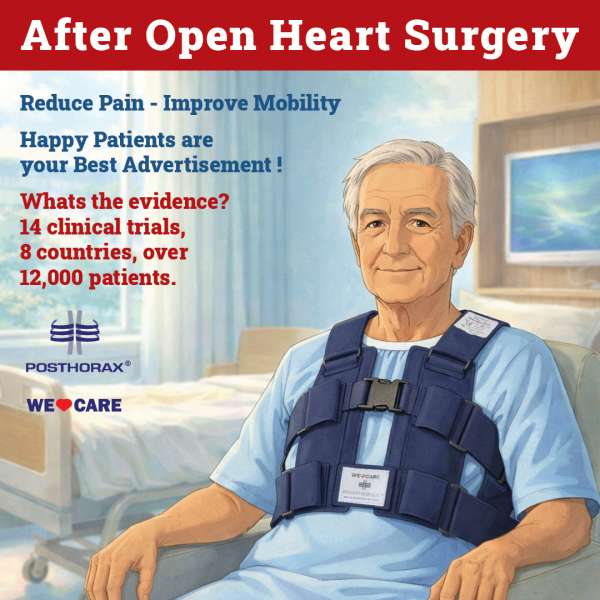
Posthorax Vest
Clinical Evidence
14 Clinical Trials, 1 Bio-med Study, 8 Countries, 12,660 patients
Request our complete Studies Brochure to explore everything we offer in more detail. You’ll find all our contact information at the end of this blog.
Total Arterial Myocardial Revascularization
Marc Albert, 2019, Stuttgart
Posthorax vest reduced sternal wound infections (p=0.036) and hospital stay for wound complications (p=0.018) after bilateral IMA.
Prevention of sternal wound complications after Sternotomy
Michael Gorlitzer, 2013, Vienna
Deep wound complications were 1.04% in vest users vs 2.27% controls; no deep infections in protocol-adherent vest users.
A randomized trial to assess the Thorax Support Vest
Philippe P. Caimmi, 2016, Italy
Vest group had lower mechanical sternal complications, better healing, no reoperation, reduced readmission, improved quality of life.
Do external support devices reduce sternal wound complications
William Tsang, 2016, UK
Non-elastic chest vest significantly reduced deep sternal complications and mean hospital stay compared to elastic bandages or none.
A newly designed Thorax Support Vest prevents Sternum instability
Michael Gorlitzer, 2009, Vienna
Sternal wound complications: 0.6% in vest group, 4.9% and 9.4% in controls; only one reoperation in vest group.
Obese Cardiac Patients: Significant Reduction
Buschmann K., 2015, Mainz
Vest group’s deep wound complication rate was 4.7% vs 10.7% in controls; vest group mobilized earlier, shorter ICU stay.
Comparison of Thorax support systems after median sternotomy
M. Gorlitzer, 2009, Vienna
Posthorax vest provided significantly higher stabilizing force than elastic bandages during breathing, coughing, and movement (p=0.001).
Significant reduction of deep sternal wound infections
Wagner FM, 2010, Hamburg
Deep wound complications: 0.88% with vest vs 2.01% without. None with constant vest use developed deep complications.
Sternum support may prevent major atelectasis
Jon Torkelson, 2012, Stockholm
Major lobar atelectasis was significantly less in vest group (p=0.02), especially among men (p=0.01); no other differences.
The first UK experience with Posthorax® Vest
N. Nikolaidis, 2013, Southampton
Despite higher risk, vest group had lower DSWC (0.9% vs 2.4%), and no mechanical sternal dehiscence vs controls.
Sternal Instability in Clinical Practice
Hans Jonsson, 2012, Stockholm
DSWI rate dropped from 2% to 0.6% post-vest; less pain, easier rehab, shorter stay, less atelectasis on x-ray.
Perioperative management and strategies to decrease sternal wound infection
H. Löblein, 2012, Zürich
Sternal infection rates reduced from 3.2% to 1.6% despite increased BIMA usage, after adding universal vest to protocol.
Use of the Posthorax Vest in patients who underwent heart surgery during cardiac rehabilitation
Silvia Di Marco, 2013, Milan
Vest did not negatively affect recovery; both groups improved equally in lung function and exercise capacity after surgery.
Sternal dehiscence in patients with moderate and severe chronic obstructive pulmonary disease
Sezai Celik, 2011, Istanbul
Dehiscence rate 1% with vest vs 11.5% without (p=.002); no deaths with vest, 35.7% mortality without.
The Benefits of the wearing of the Posthorax® Vest
Fanni Vörös, 2021, Budapest
Despite higher risk, reoperations for infection dropped from 2.7% to 1.8% with vest; broader use could further decrease complications.
Contact:
- EU +421 (0) 940 269 102 www.posthorax.com
- USA +1 (407) 505-9357 www.posthorax.us
- WhatsApp Link: https://wa.me/421940269102
- Email: info@posthorax.com
Request our complete Studies Brochure to explore everything we offer in more detail.


