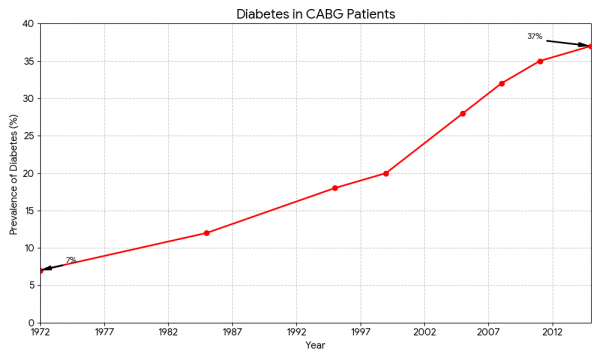
Diabetes In CABG Patients
Tracking Diabetes Through the Years: Key Findings from Raza et al, 2015, Cleveland Clinic CABG Study
The study by Raza et al. 2015 at the Cleveland Clinic USA examines four decades of trends in the prevalence of diabetes among patients undergoing coronary artery bypass grafting (CABG) and evaluates how diabetes affects short-term outcomes, resource utilization, and long-term survival.
Using a large cohort of 55,501 patients who underwent first-time CABG between 1972 and 2011, the authors compared 10,362 pharmacologically treated diabetics with 45,139 nondiabetics.
Median follow-up was 12 years, and cost data were available from 2003 onward. Propensity matching was employed to minimize baseline differences between groups.
The prevalence of diabetes among CABG patients rose dramatically, from 7% in the 1970s to 37% in the 2000s, reflecting the growing burden of diabetes in cardiovascular disease.
Diabetic patients consistently experienced worse in-hospital outcomes compared with nondiabetics.
Specifically, they had higher rates of in-hospital mortality (2.0% vs 1.3%), deep sternal wound infections (2.3% vs 1.2%), stroke (2.2% vs 1.4%), renal failure (4.0% vs 1.3%), and prolonged postoperative hospital stays (9.6% vs 6.0%) (all P < .05).
These complications translated into greater resource utilization and increased costs, with diabetic patients incurring 9% higher hospital costs.
Long-term survival was also significantly worse for diabetics.
Survival rates at 1, 5, 10, and 20 years were 94%, 80%, 56%, and 20%, respectively, compared with 94%, 84%, 66%, and 32% in nondiabetics.
Even after propensity matching, which balanced clinical characteristics and eliminated cost differences, diabetics continued to have higher rates of deep sternal wound infections and stroke, as well as poorer long-term survival.
The authors conclude that diabetes is both a marker of high-risk, resource-intensive care and an independent predictor of reduced long-term survival after CABG. Given the increasing proportion of CABG patients with diabetes, these findings highlight a growing clinical and economic challenge. Strategies aimed at improving perioperative management and long-term outcomes in diabetic patients are essential to curb rising healthcare costs and improve survival.
Link: https://pubmed.ncbi.nlm.nih.gov/26027913/
Contact:
EU +421 (0) 940 269 102
USA: +1 (407) 505-9357
WhatsApp Link: https://wa.me/421940269102
Email: info@posthorax.com
Web: www.posthorax.com


