Diabetes and Bone Healing
Delayed, Non Union and Fracture Risk
Diabetes significantly impairs bone healing, leading to delayed union, non-union, and increased fracture complications. Fracture healing in diabetic patients is prolonged by 87%, with a 3.4-fold higher risk of complications such as redislocation or pseudoarthrosis (1).
Peripheral neuropathy, high HbA1c levels (>7%), and prolonged surgery duration are key predictors of impaired bone healing in diabetic individuals (2).
The diabetic environment affects bone quality by altering its organic composition and biomechanical properties, rather than bone mineral density (BMD) alone (3).
Reduced osteoblast activity and defective skeletal progenitor cells further contribute to delayed or failed bone union (4) (5).
(1) Diabetes and Its Effect on Bone and Fracture Healing, 2015, USA https://pmc.ncbi.nlm.nih.gov/articles/PMC4692363/
(2) The Impact of Type 2 Diabetes on Bone Fracture Healing, 2018, Belgium https://www.frontiersin.org/journals/endocrinology/articles/10.3389/fendo.2018.00006/full
(3) Impact of Diabetes Mellitus on Bone Health, 2019, Ireland https://pmc.ncbi.nlm.nih.gov/articles/PMC6801685/
(4) Update on the impact of type 2 diabetes mellitus on bone metabolism and material properties, 2019, Germany, Italy, USA https://pmc.ncbi.nlm.nih.gov/articles/PMC6391903/
(5) Impaired Bone Fracture Healing in Type 2 Diabetes Is Caused by Defective Functions of Skeletal Progenitor Cells, 2022, UK https://doi.org/10.1093/stmcls/sxab011
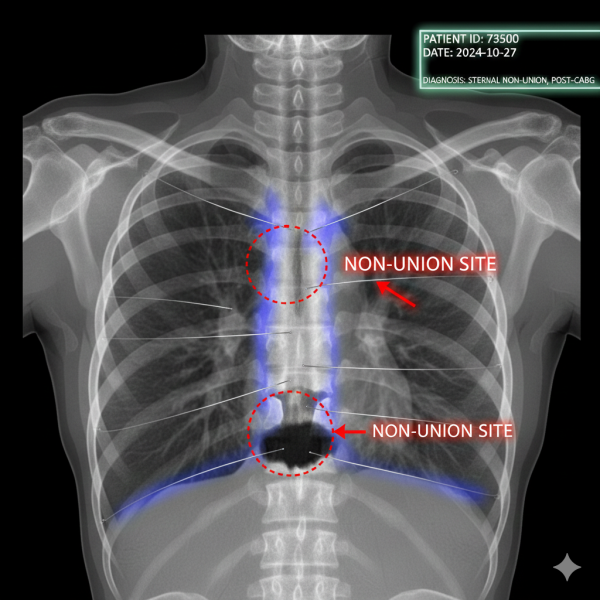
WHAT DOES THE BLOG PICTURE DISPLAY
That "big hole" or gap at the bottom of the sternum represents a complete failure of the bone to knit back together, which is the hallmark of a sternal non-union.
Following a Coronary Artery Bypass Graft (CABG), the sternum is typically held together with surgical wires. When those wires fail to stabilize the bone or if there is poor blood supply, the two halves of the bone can pull apart rather than fusing.
What You Are Seeing
The Sternal Gap: The dark space (the "hole") is where the bone should be continuous. In a healthy recovery, that area would be filled with dense, white bone matter.
Sternal Dehiscence: This is the clinical term for the separation. The gap at the bottom suggests the lower portion of the sternal cut has widened significantly, which often causes a "clicking" or "grinding" sensation when the patient breathes or moves.
Wired Hardware: You can see the thin horizontal lines; those are the stainless steel wires. If you notice them looking displaced or broken near that gap, it’s a sign that the mechanical tension was too great for the bone to heal.
Why it Happens
Non-union at the lower part of the sternum is actually quite common because that area (the xiphoid process and lower body) is subject to a lot of mechanical stress from the diaphragm and abdominal muscles.
Factors like diabetes, obesity, or chronic coughing can put extra pressure on those surgical wires, leading to the separation you see.
Contact:
EU +421 (0) 940 269 102
USA: +1 (407) 505-9357
WhatsApp Link: https://wa.me/421940269102
Email: info@posthorax.com
Web: www.posthorax.com


