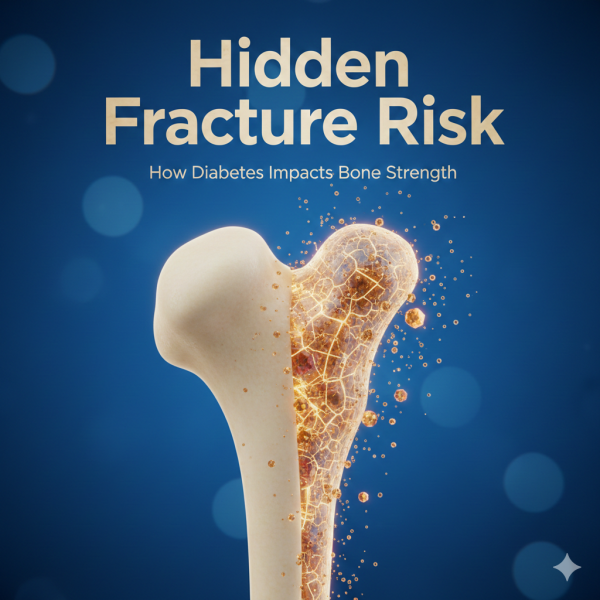
How Diabetes Impacts Bone Strength
Failure of the Chest Bone Fracture to Achieve Union Presents a Major Risk Factor for Long-Term Disability
For most patients, the expectation after surgery is a steady, if slow, return to wholeness. But for the millions of HEART PATIENTS with diabetes, the body’s healing - the delicate process of knitting bone back together - often stalls, leaving patients in a painful state of known as "non-union."
New clinical data suggests that the biological toll of diabetes on the skeleton is far more aggressive than previously understood.
Research indicates that fracture healing in diabetic patients is prolonged by a staggering 87 percent, with a nearly fourfold increase in complications like redislocation or pseudoarthrosis - a "false joint" formed when bones fail to fuse.
Journal of Diabetes Research (2015), USA https://pmc.ncbi.nlm.nih.gov/articles/PMC4692363/
A Structural Failure Under the Surface
The challenge of diabetic bone healing is perhaps most visible in the aftermath of open-heart surgery. To access the heart, surgeons must saw through the sternum, later securing it with stainless steel wires. In a healthy recovery, these wires hold the bone steady until it fuses into a solid shield.
In diabetic patients, however, this process frequently fails. Radiologists often point to a "sternal gap" - a dark, empty space at the bottom of the chest bone where dense white matter should be. This "hole" is the hallmark of sternal dehiscence, a clinical separation that can cause an agonizing "clicking" or "grinding" sensation every time a patient breathes or moves.

"The lower part of the sternum is a high-traffic area," says the medical literature. It is subject to constant mechanical stress from the diaphragm and abdominal muscles. When combined with the vascular limitations of diabetes, the surgical wires often cannot hold the tension, and the bone simply pulls apart.
Quality Over Quantity
The traditional metric for bone health has long been Bone Mineral Density (BMD). Yet, recent studies from Ireland and Italy suggest that for diabetics, the density of the bone is a secondary concern. The real culprit is the organic composition of the bone itself.
Diabetes-induced hyperglycemia (excess of glucose in the blood stream) alters the structural composition of the bone matrix and stunts cell growth: Reduces the activity of osteoblasts, the cells responsible for building new bone.
World Journal of Diabetes (2019), Ireland https://pmc.ncbi.nlm.nih.gov/articles/PMC6801685/
Shutterstock © 2026
The Predictors of Risk

Understanding Sternal Non-Union
The "big hole" or gap described in post-CABG (bypass) patients is a specific manifestation of these systemic failures.
Mechanical Stress The lower sternum (xiphoid process) is uniquely vulnerable because it serves as an anchor point for the diaphragm.
Hardware Failure When the "diabetic environment" prevents the bone from knitting, the constant motion of breathing puts excessive tension on the surgical wires. Eventually, the bone either cuts through the wires or the wires pull through the softened, poor-quality bone.
Sternal Dehiscence This separation results in the "dark space" on imaging, where the lack of white opacity indicates a complete absence of new, calcified bone matter.
Medical professionals are now identifying clear "red flags" that can predict whether a patient’s bone will fail to heal. High HbA1c levels (above 7 percent) and the presence of peripheral neuropathy are key indicators.
The Posthorax vest stabilizes the sternum, holding the two halves together until successful bone union is achieved. (Tested in 14 Clinical Trials, 8 Countries, in over 12,0000 patients) https://posthorax.com/studies
Contact:
EU +421 (0) 940 269 102
USA: +1 (407) 505-9357
WhatsApp Link: https://wa.me/421940269102
Email: info@posthorax.com
Web: www.posthorax.com


